> ## Documentation Index
> Fetch the complete documentation index at: https://docs.erstan.com/llms.txt
> Use this file to discover all available pages before exploring further.
# Working with agents in chat
> Direct a conversation to a specific agent with @mentions, then follow its run step by step.
By default, chat talks to **Erstan** — the default assistant that can search and act on your NetSuite data. When you want a specific expert on the job, **@mention an agent** to route the conversation to it, then watch its run unfold in the same transcript.
 ## Mention an agent
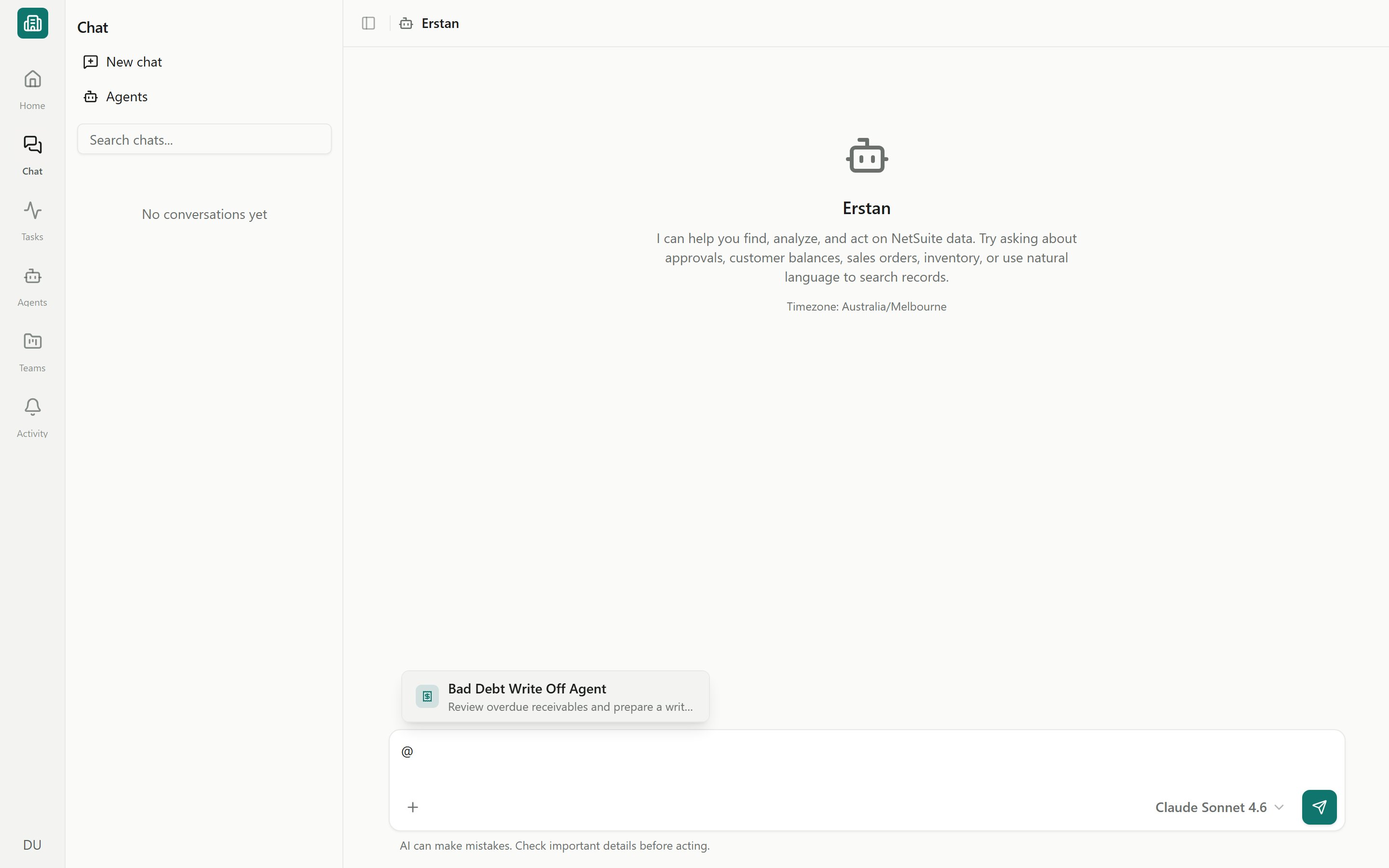
Type `@` in the composer (placeholder **"Ask anything, or @mention an agent"**) to open the mention picker. You can address either an **[Agent](/agents/overview)** or a workspace **member**.
The mention picker appears. Keep typing to filter by name.
Choose the agent you want to handle the request. Picking an agent scopes the conversation to it.
The chat routes to that agent. The header and placeholder update to the agent's name (for example, **"Ask {agent}…"**), and the thread is grouped under the agent's name in your chat history.
Mention a **teammate** instead of an agent to bring a person into the thread — useful for handoffs and questions that need a human.
An agent-scoped chat behaves like the agent you mentioned: it uses that agent's instructions, skills, and connected tools. A plain chat with **Erstan** (the default assistant) uses the workspace defaults instead.
## Agent thread actions
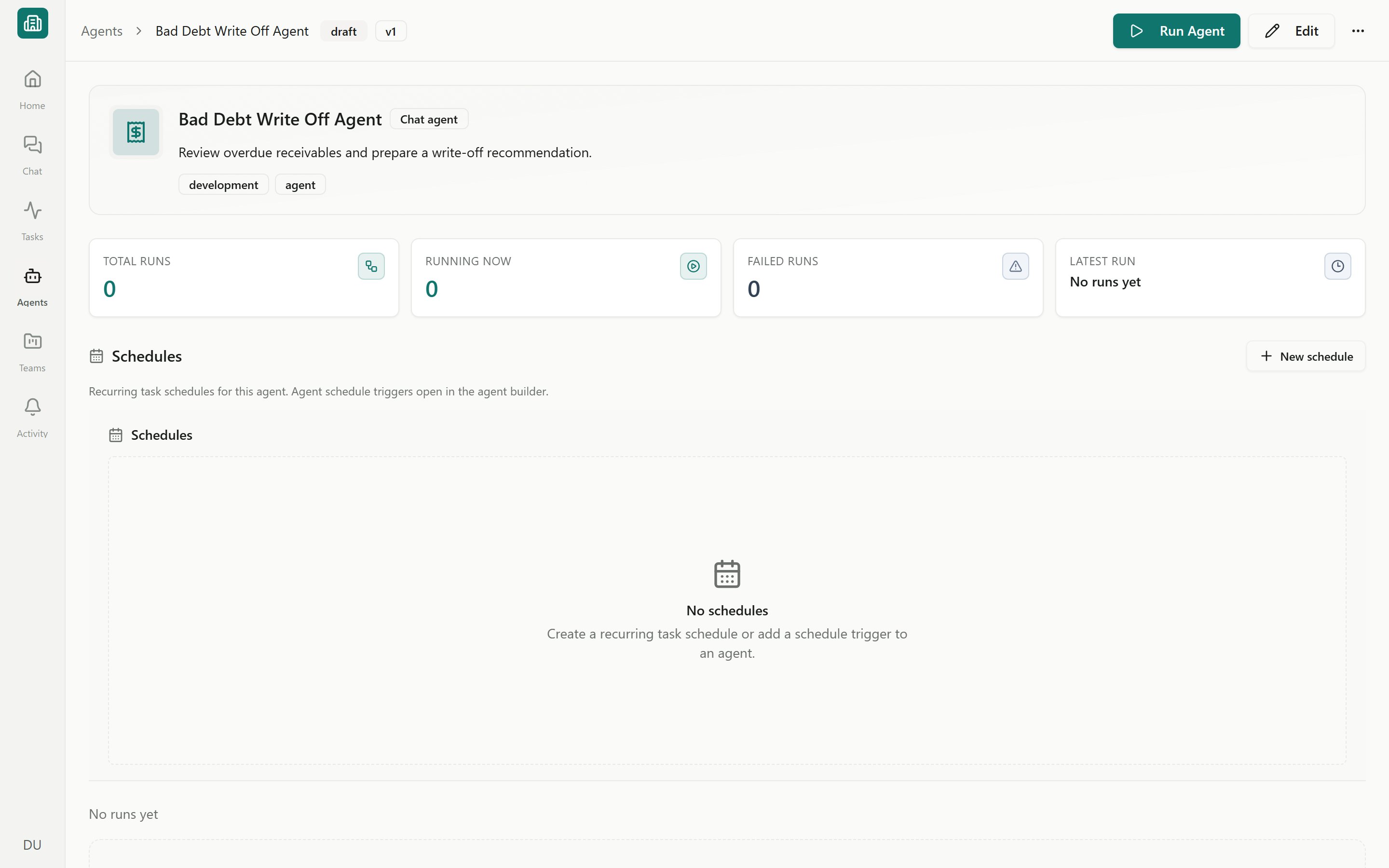
Once a conversation is scoped to an agent, the thread exposes shortcuts to manage and inspect that agent — from the thread's menu in the chat history panel and from the agent-scoped chat header.
| Action | What it does |
| -------------------- | ------------------------------------------------------------------------------------------------ |
| **Run Agent** | Start a fresh run of the agent, opening its run dialog (trigger inputs and any starter prompts). |
| **View Agent Setup** | Open the agent's configuration to see its trigger, steps, instructions, skills, and tools. |
| **View Run History** | Jump to the agent's run history — summary cards plus every past run. |
| **View Run** | Open the detail page for the run tied to this thread. |
Builder, triggers, schedules, run history, and traces all live under Agents.
## Follow a multi-step run
Some agents — especially **Workforces** and **Automations** — execute a multi-step run rather than a single reply. When that happens, a **run workspace** (Steps) panel becomes available alongside the transcript so you can watch the pipeline progress live.
Use **Open Run** / **Show run steps** to reveal the steps panel (look for the list-tree icon in an agent-scoped chat).
Each step shows its live status as the run streams. Tool calls and reasoning can appear inline in the transcript as well.
If a step needs your sign-off, an approval card appears above the composer; respond there without leaving the chat.
Use **Hide run steps** / **Close Run** to collapse the panel, then reopen it any time.
The **Show agent progress** toggle in the composer **+** menu controls whether step-by-step progress is surfaced. It mainly applies to agent-scoped chats, not plain chat with Erstan.
When an agent's run reaches a step that **writes to NetSuite** (or another connected system), it pauses for an **approval** before anything changes. Review the action and its Before/After preview, then choose **Run action** or **Don't run**. Writes never go through silently unless **Auto-approve writes** is enabled. See [Approving and rejecting AI actions](/chat/approvals).
## Where the run lives afterward
Every agent run from chat is tracked. To revisit it later:
* **In chat** — reopen the thread; it stays grouped under the agent's name with a live status indicator (for example, running or failed).
* **In run history** — use **View Run History** to see the run table, traces, and outcomes. See [Run history, traces & analytics](/agents/run-history-traces).
* **In Tasks** — work an agent kicks off can surface as a [task](/tasks/overview) that moves through Queued → In Progress → Needs Review → Complete.
## Mention an agent
Type `@` in the composer (placeholder **"Ask anything, or @mention an agent"**) to open the mention picker. You can address either an **[Agent](/agents/overview)** or a workspace **member**.
The mention picker appears. Keep typing to filter by name.
Choose the agent you want to handle the request. Picking an agent scopes the conversation to it.
The chat routes to that agent. The header and placeholder update to the agent's name (for example, **"Ask {agent}…"**), and the thread is grouped under the agent's name in your chat history.
Mention a **teammate** instead of an agent to bring a person into the thread — useful for handoffs and questions that need a human.
An agent-scoped chat behaves like the agent you mentioned: it uses that agent's instructions, skills, and connected tools. A plain chat with **Erstan** (the default assistant) uses the workspace defaults instead.
## Agent thread actions
Once a conversation is scoped to an agent, the thread exposes shortcuts to manage and inspect that agent — from the thread's menu in the chat history panel and from the agent-scoped chat header.
| Action | What it does |
| -------------------- | ------------------------------------------------------------------------------------------------ |
| **Run Agent** | Start a fresh run of the agent, opening its run dialog (trigger inputs and any starter prompts). |
| **View Agent Setup** | Open the agent's configuration to see its trigger, steps, instructions, skills, and tools. |
| **View Run History** | Jump to the agent's run history — summary cards plus every past run. |
| **View Run** | Open the detail page for the run tied to this thread. |
Builder, triggers, schedules, run history, and traces all live under Agents.
## Follow a multi-step run
Some agents — especially **Workforces** and **Automations** — execute a multi-step run rather than a single reply. When that happens, a **run workspace** (Steps) panel becomes available alongside the transcript so you can watch the pipeline progress live.
Use **Open Run** / **Show run steps** to reveal the steps panel (look for the list-tree icon in an agent-scoped chat).
Each step shows its live status as the run streams. Tool calls and reasoning can appear inline in the transcript as well.
If a step needs your sign-off, an approval card appears above the composer; respond there without leaving the chat.
Use **Hide run steps** / **Close Run** to collapse the panel, then reopen it any time.
The **Show agent progress** toggle in the composer **+** menu controls whether step-by-step progress is surfaced. It mainly applies to agent-scoped chats, not plain chat with Erstan.
When an agent's run reaches a step that **writes to NetSuite** (or another connected system), it pauses for an **approval** before anything changes. Review the action and its Before/After preview, then choose **Run action** or **Don't run**. Writes never go through silently unless **Auto-approve writes** is enabled. See [Approving and rejecting AI actions](/chat/approvals).
## Where the run lives afterward
Every agent run from chat is tracked. To revisit it later:
* **In chat** — reopen the thread; it stays grouped under the agent's name with a live status indicator (for example, running or failed).
* **In run history** — use **View Run History** to see the run table, traces, and outcomes. See [Run history, traces & analytics](/agents/run-history-traces).
* **In Tasks** — work an agent kicks off can surface as a [task](/tasks/overview) that moves through Queued → In Progress → Needs Review → Complete.
 ## Next steps
Meet Assistants, Workforces, and Automations.
Review write actions before they run.
Control what an agent can see and use in chat.
Read a run's step-by-step trace.
## Next steps
Meet Assistants, Workforces, and Automations.
Review write actions before they run.
Control what an agent can see and use in chat.
Read a run's step-by-step trace.